David B. Katague is an online memoirist and cultural essayist whose writing has appeared on HubPages

Monday, April 8, 2024

From My In-Box Today- Cornish Pasties in Grass Valley, CA

It’s Monday. How Cornish pasties became a favorite in a California gold rush town. 

Carrie Locks, wearing a white hairnet, brushing two rows of pastries on a tray.
Carrie Locks, owner of Marshall’s Pasties, prepares a tray of Cornish pasties. Jim Wilson/The New York Times

In a charming former mining town in the Sierra Nevada foothills, you can taste pieces of California history dating back nearly 175 years.

Their crusts are buttery and flaky, with steaming layers of meat and vegetables inside. These are pasties, crescent-shaped hand pies that originated as a lunch food for miners in Cornwall, England, and have become a mainstay in Grass Valley, 60 miles northeast of Sacramento.

The pasty — pronounced “pass-tee,” rhyming with “nasty” — arrived in California with Cornish workers who began emigrating to the gold fields in the 1850s to toil in the rich mines near Grass Valley, like the Empire mine. By the end of the century, three-quarters of Grass Valley residents were of Cornish descent.

Though that’s no longer the case (and the last of the mines closed decades ago), their Cornish traditions live on.

An array of rusted mining equipment in front of a white building on a snowy day.
Snow falls on mining equipment at Empire Mine State Park in Grass Valley, one of the oldest, deepest and richest gold mines in the state. Jim Wilson/The New York Times

Grass Valley, which is home to roughly 14,000 people, hosts an annual festival for St. Piran, the patron saint of Cornwall, and celebrates Christmas with Cornish carols and folk tunes written long ago by homesick miners. And, of course, the town still cherishes and serves up the pasty.

“It’s our heritage food,” said Gage McKinney, a local historian who is descended from some of the earliest Cornish immigrants to Grass Valley. “You bite into a pasty, it connects you with all this legacy, which is only vague in your mind, but becomes visceral in your mouth. Any place where the Cornish heavily settled, you can find a good pasty.”

The pasty spread all over the world in the 1800s with the Cornish, who were in high demand for their hard-rock mining know-how: Cornwall, in the southwestern tip of Britain, had been mining for tin and other metals since pre-Roman times. Pasties are now a favorite food in the Upper Peninsula of Michigan, where copper mines attracted Cornish workers, and in Mineral Point, Wis., where zinc and lead mines were a draw. In the former silver mining town of Real del Monte in central Mexico, pasties caught on so well that there is now an annual pasty festival and a pasty museum.

People sitting at table eating and ordering at a counter. A menu of pasties is on the wall.
Marshall’s Pasties has been open since 1968. Jim Wilson/The New York Times

In Grass Valley, there’s no record of a pasty shop being in business before the 1900s, most likely because families were baking them at home, Comstock’s Magazine reported. “But after the last mines closed in the 1960s,” the magazine said, “Grass Valley began to capitalize on its mining history instead of its minerals.”

Two shops in Grass Valley specialize in the pasties today: Marshall’s Pasties, which has been cooking the savory turnovers since 1968, and Grass Valley Pasty Co., which opened in 2019. The trendy Corvus Bakery in town sells gluten-free hand pies, and the neighborhood church bakes more than 1,000 pasties once a month as a fund-raiser.

Continue reading the main story


Though local shops make all kinds of flavor variations now, the traditional Cornish recipe calls for diced skirt steak, potato, onion and rutabaga. In the old days, McKinney told me, miners’ wives would sometimes bake a sweet filling like apples into one end, so miners could finish their meal with a little dessert.

A vegetable pasty sits in the front and a ham and cheese one in the back. Jim Wilson/The New York Times

In the mines, Cornish men, known as Cousin Jacks, would light a candle and use it to heat a lunch pail with two compartments: Tea in the bottom compartment would steam the portable pie on top. The pasty’s crimped crust served as a handle that miners would discard after eating, to avoid consuming any arsenic or other metals that may have been on their fingers.

Continue reading the main story


“They had this full meal in a crust that they could take underground,” said McKinney, a fifth-generation Grass Valley resident. “The Cornish pasty was very much part of the wherewithal of this industrial work force that brought industrialization to pristine places like the foothills.”

As I was waiting to buy lunch recently at Grass Valley Pasty Co., where you can watch cooks shape dough into half-moons, an older man in line ahead of me told the cashier that his grandfather had worked in a mine in nearby Amador County. He said his family had its own passed-down pasty recipe, but it was easier to pick some up from the shop.

After surveying the options, he decided that the closest flavor to what his family made was the Cousin Jack, stuffed with skirt steak, potatoes, onion and parsley. He left clutching a paper bag with two warm pasties inside.

Source: New York Times, California Today

Personal  Note: The David B Katague clan resided in Fair Oaks, Ca for over 20 years. We have been to Grass Valley several times, but I am ashamed to admit, I am ignorant of the history of these savory pies. This is an example of the saying, you are never too old to learn new things every day. Have a Good day Everyone. I promised next time, If perchance I will be in the vicinity of Grass Valley, tasting these pasties would be in my bucket list. 

Friday, April 5, 2024

Top Ten Most Popular Dishes in Europe

In my recent postings, I mentioned that the Filipino Soup _Pork Sinigang was listed by TasteAtlas as the Number 1- best tasting soup in the world. In this posting I am listing the top ten popular Dishes in Europe and most photographs foods in the world. This was based on monthly Google searches by Photobox.  

Based on the volume of monthly Google searches by internet users between November 2021 and October 2022, Photobox has investigated to reveal the list of the most popular foods in Europe and the most photographed foods in the world. It is a proof, that most everyone loves good food and loves sharing it, in all the various cultures across the globe

Italian, Japanese and American foods are the most popular in Europe

To find these results, Photobox analysed the 10 most recognisable and famous dishes in the world based on search hits for terms related to these, to determine which were the most popular and in which European countries (among the 20 most populous countries in the EU). The result, according to Europe’s leading photo printing company, is that the top five most popular culinary dishes in Europe are:

  1. Pizza
  2. Ramen
  3. Burger
  4. Paella
  5. Moussaka

Pizza and Ramen are the most popular dishes in Europe, with an average of almost 11 million and two million Google searches per month each. But while the Napolitan dish takes the cake, surprisingly the Italian speciality was most popular in Bulgaria, while the Japanese broth and noodle dish was most popular in Sweden.

Italian pizza is the most photographed food in the world

And since most foodies took up the habit of taking a shot of their food and Instagramming it before eating, Photobox also looked at the 10 most photographed foods in the world. Using hashtags from the app, the online photo printing company found that pizza was the most photographed food out of their data, with over 64,000,000 hashtags. Right behind it, still on the podium: ramen and burgers. 

Here is the top 10: From en-vols. com on the top ten most popular dishes in the world.

  1. Pizza
  2. Burger
  3. Ramen
  4. Paella
  5. Pierogi
  6. Moussaka
  7. Boeuf Bourgignon
  8. Eisbein
  9. Tom Kha Gai
  10. Chicken Tikka Massala

https://www.en-vols.com/en/taste/gastronomy/most-popular-dishes-world/

Most Popular Asian Food Dishes
  • Sushi (Japanese Dish) ... 
  • Kimchi (Korean Sauerkraut) ... 
  • Biryani (Indian Rice-based Dish) ... 
  • Pho (Vietnam) ... 
  • Tom Yam (Thailand) ... 
  • Nasi Goreng (Malaysia/Indonesia) ... 
  • Dim Sum (China) ... 
  • Hainanese Chicken Rice (Singapore)
The above are the eight most popular dishes in Asia.
Enjoying A Delicious Dinner with Jay, Martha and Natalie. 

I Was in Gustatory Heaven with Pork Barbecue Buns


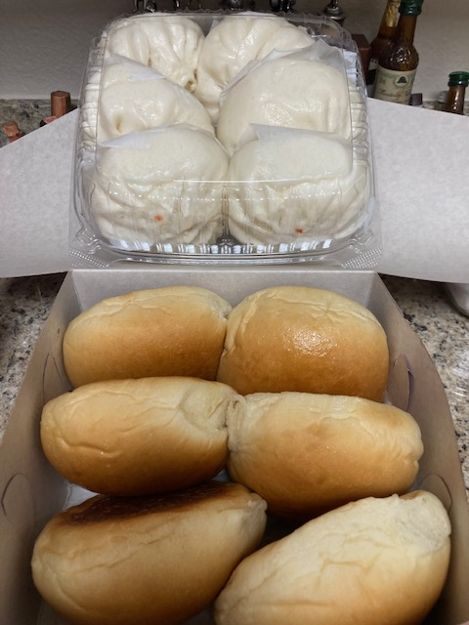
Two weeks ago, Thursday Afternoon, during my mahjong session, Sabrina Monahan, Our THD Zumba Guru delivered to me a dozen huge barbecue pork buns( siopao) from a bakery in China Town in San Francisco for my gastronomic indulgence.  

I had one that afternoon for my snack💚which ruined my appetite for my dinner of chicken wrapped in Bacon here at THD.  But I had no regret. The huge buns were moist and delicious. Every bite is a journey of culinary delight.

I ordered a dozen  (6 steamed and 6 baked).  I plan on freezing them and just microwave one at a time when I have a cravings for the buns. It will be next month, when Sabrina can go to China Town in San Francisco for a reorder. In the Philippines, the barbecue buns are called Siopao. So what is Siopao.  

Siopao is derived from the baozi, introduced by Hokkien Chinese immigrants to the Philippines during the Spanish colonial period. The name is derived from Philippine Hokkien sio-pau (simplified Chinese: 烧包; traditional Chinese: 燒包; Pe̍h-ōe-jī: Sio-pau; lit. 'hot bun').

Siopao is derived from the baozi, introduced by Hokkien Chinese immigrants to the Philippines during the Spanish colonial period. The name is derived from Philippine Hokkien sio-pau (simplified Chinese: 烧包; traditional Chinese: 燒包; Pe̍h-ōe-jī: Sio-pau; lit. 'hot bun'). Historically, the most popular siopao buns in Manila were the ones made by restaurateur Ma Mon Luk at the turn of the 20th century.

Siopao differs from the baozi in that it is much larger and is eaten held in the hands like a sandwich. It also uses different traditional fillings. The most common fillings are pork asado (indigenized braised version of the Cantonese char siu) and bola-bola (literally "meatball", a combination of pork, chicken, beef, shrimp or salted duck egg). Siopao uses leavened wheat flour and is traditionally steamed, but a baked version (also called "toasted siopao") can be baked directly in ovens without steaming. A popular variant called "fried siopao" fries the bottom of the siopao in a greased skillet after steaming. Another dish that evolved from the siopao is the asado roll, which uses regular bread dough and is baked.

Traditional siopao is also typically accompanied with a sweet and sour "siopao sauce" (made from cornstarch, soy sauce, sugar, garlic, and other ingredients), which is injected or spread unto the filling before eating. Plain ketchup (either tomato ketchup or banana ketchup) is also used in the same way. In contrast to the baozi which is eaten dipped in a soy sauce or vinegar mixture.

A unique variant from Siargao Island is the paowaw, a dessert bun which has a filling of bukayo(sweetened shredded coconut meat). Here's additional information from Wikipedia on Barbecued Pork Buns.

Cha siu bao
Alternative namesChashaobao, manapua, keke pua'a, chao pao
TypeDim sum
Place of originSouthern China
Serving temperatureHot
Main ingredientsPork
VariationsBaked or steamed
Food energy
(per serving)
501.2 kcal (2098 kJ)
Cha siu bao
Simplified Chinese叉烧包
Traditional Chinese叉燒包
Jyutpingcaa¹ siu¹ baau¹
Cantonese Yalechā sīu bāau
Hanyu Pinyinchāshāo bāo
Literal meaningbarbecued pork bun
Baked cha siu bao dough for this type is different from the steamed version

Cha siu bao (simplified Chinese: 叉烧包; traditional Chinese: 叉燒包; pinyin: chāshāo bāo; Jyutping: caa1 siu1 baau1; Cantonese Yale: chā sīu bāau; lit. 'barbecued pork bun') is a Cantonese  baozi (bun) filled with barbecue-flavored cha siu pork. They are served as a type of dim sum during yum cha and are sometimes sold in Chinese bakeries.

Varieties

There are two major kinds of cha siu bao: the traditional steamed version is called 蒸叉燒包 (pinyin: zhēng chāshāo bāo; Jyutping: zing1 caa1 siu1 baau1; Cantonese Yale: jīng chāsīu bāau) or simply 叉燒包(chāshāo bāo; caa1 siu1 baau1; chāsīu bāau), while the baked variety is usually called 叉燒餐包 (chāshāo cān bāo; caa1 siu1 caan1 baau1; chāsīu chāan bāau). Steamed cha siu bao has a white exterior, while the baked variety is browned and glazed.


Meanwhile here's a list of most Popular Filipino Meriendas ( Snacks). Makes me Hungry, Again!

Monday, March 18, 2024

St Patricks Day Dinner- A Gastronomic Success

From Left to Right: Doris Rosen, ME, Peggy Yamada( new Resident) and Patty Healy 

Last Saturday,  March 16 was our Special St Patricks Dinner featuring Corned Beef and Cabbage, with Boiled Potatoes, Carrots and Horse Radish.  The photo above is My Dinner Table, with Doris Rosen, Patty Healy and Newcomer Peggy Yamada.   I wore my light green short sleeve Polo Barong.  
The Irish Soda Bread was out of this world. I had 2 scopes of Pistachio Ice cream. The ice cream matches the color of my shirt. A few of the residents were wearing green outfits for the occasion. 
The only missing in the Dinner is Green Beer. Here are some photos I took for your viewing pleasure.


St. Patrick's Day Foods
  • Colcannon. Colcannon, or Irish mashed potatoes, is a traditional Irish dish that has been consumed in the country for generations. ... 
  • Irish Soda Bread. ... 
  • Fried Cabbage. ... 
  • Corned Beef and Cabbage. ... 
  • Shepherd's Pie. ... 
  • Irish Stew. ... 
  • Irish Apple Tart. ... 


The above are the typical St Patricks Day Foods.  

Saturday, March 16, 2024

A Big Year for Cabbage- Kimchi and Caraflex


Found in my Inbox Recently from the New York Times-The World of Cabbage

In a world in which it’s hard for a vegetable to get a break, cabbage is winning.

Cabbage has been a global culinary workhorse for centuries. (China grows the most; Russia eats the most.) It has fed generations of American immigrants. But now, a vegetable that can make your house smell like a 19th-century tenement has become the darling of the culinary crowd. A purple ( red) Cabbage, a variety I loved. 

In the words of my mother-in-law: Cabbage, who knew?

Like so many American food trends, fancy cabbage dishes first started turning up in restaurants on the coasts a few years ago. But they are fast spreading across the country. One chef has compared this cabbage mania to the hoopla over bacon in the 1990s.

In Denver, Sap Sua sprinkles a charred cabbage wedge with anchovy breadcrumbs. Cabbage is bathed in brown-butter hollandaise at Gigi’s Italian Kitchen in Atlanta. At Good Hot Fish in Asheville, N.C., shredded green cabbage stars in a pancake punched up with sorghum hot sauce.

For a story in The Times, I spoke with farmers, chefs and food critics and ate cabbage in three cities, seeking to understand how the vegetable earned this moment in the spotlight. In today’s newsletter, I’ll explain what I found.

Kimchi and Caraflex💥

An oval plate with a quartered cabbage dish and a knife and fork on a napkin.
A cabbage dish at Chi Spacca in Los Angeles.  Michelle Groskopf for The New York Times

The trajectory of a food trend in the United States can sometimes be easy to trace. A French chef introduces the heavily salted butter caramels of Brittany to the elite of the American food world, pastry chefs at expensive restaurants start to play with the idea, and before you know it, you’re ordering a salted caramel cold brew from Dunkin’.

But tracking down Cabbage Zero, the one that started the current cruciferous renaissance, is not as easy as tipping a hat to Roy Choi for wrapping kimchi and bulgogi in a corn tortilla, thus kicking off the Korean taco craze.

Kimchi, whose main ingredient is cabbage, has helped the cause. Its meteoric rise among cooks and diners who weren’t raised in Korean households has been buoyed by the interest in all things fermented and gut-friendly (much to the chagrin of some purists, who hate what they refer to as “hipster kimchi”). There was even a spike in sauerkraut and kimchi sales when people thought fermented cabbage might ward off Covid.

Cabbage can also thank brussels sprouts, the gateway Brassica that worked its way onto menus after the chef David Chang started pan roasting it with bacon at Momofuku Noodle Bar in 2004.

None of this would be happening without farmers, of course. A decade or so ago, farmers who sell largely to restaurants began to grow more specialty cabbages, like the small, tender Caraflex, often called the conehead or arrowhead because of its pointy tip.

Chefs looking to create dishes for a new, plant-forward world discovered that coneheads looked gorgeous when quartered and sauced on a plate, and were easy to braise, roast or char.

The Ornamental Purple Cabbage in My Garden

The trend is still going strong. Leaves of purple cabbage are enlisted to swaddle mapo tofu at Poltergeist, the current culinary fascination in Los Angeles. At Superiority Burger in New York City, cabbage is gently enrobing sticky rice studded with tofu and braised mushrooms.

Of course, most of the cabbage Americans eat is still in the form of coleslaw or, to a lesser degree, sauerkraut. And the Department of Agriculture notes that the amount of cabbage Americans eat measured per capita is about six pounds. In 2000, it was closer to nine.

Still, among the food-forward, cabbage fever is rising.

“I think 2024 is going to be a really exciting year in cabbage,” the celebrity farmer Lee Jones, of the Chef’s Garden in Huron, Ohio, predicted.

💥It's Caraflex cabbage, a sweeter Bantam variety with lettuce-like crunch that has recently found favor among chefs and farmers alike. The immediately recognizable coneheaded cabbage tends to be harvested at just a pound or so, though these narrow romaine-heart-size heads can easily grow much larger.Continue reading the main story


Here's our St Patrick's Dinner Menu featuring Corned Beef and Cabbage with Boiled Potatoes, Carrots and Horseradish. Looking forward to the Pistachio ice cream for dessert ( 2 scopes). Enjoy Everyone!


Lastly, my apology if you find this posting boring and irrelevant. I guarantee you my next posting will be more interesting and informative.


Related Posts Plugin for WordPress, Blogger...